


The first credit cards date back to the 1950s. By the 1980s, cards had spread around the world and quickly began replacing cash.
In Australia, too, the use of payment cards is growing. A Reserve Bank of Australia survey of consumer payment methods shows that in 2022 only 19 percent of payments were made in cash. According to the same survey, more than 70 percent of payments under $10 were also made by card, up from around 50 percent in 2019.
Among the different types of cards, debit cards accounted for about 58.4 percent of the total value of payments in 2023.
In this PickTalk article, we introduce credit cards and debit cards and compare how they work and what each one offers.
What Is a Credit Card?
A credit card is a type of payment card issued by a bank or financial institution. You can use it for financial transactions and even online shopping. These cards usually come with a set credit limit and interest rate, determined by the applicant’s financial activity.
You might think ordinary bank cards do exactly the same thing. But the key difference with a credit card is that it’s based on credit. More precisely, a credit card is a kind of short-term loan given to you in the form of a card. When you pay with it, no money is taken out of your bank account. Instead, you owe the bank that issued your credit card and must pay it back by the due date. With a debit card, on the other hand, the money comes out of your account straight away.
Benefits of Using a Credit Card
In general, credit cards are designed to make payments and financial transactions easier. They also have other benefits, including:
- International purchases (both in person and online)
- A grace period to repay what you owe to the card issuer
- Very high security
- Cash withdrawals from ATMs
- Access to internet banking
- Transfers to international accounts
What Is a Debit Card?
A debit card is also a type of bank or payment card, but instead of drawing on a loan or credit from a financial institution, it’s linked to your bank account. This means you can only spend up to the balance in your bank account.
When you pay with a debit card, the amount is deducted from your account but isn’t paid into the seller’s account immediately. It’s held by your bank for a limited time (usually 24 hours) and then transferred to the seller’s account. This delay is part of how debit cards work, helping to prevent money laundering and financial fraud.
Benefits of Using a Debit Card
Debit cards have become increasingly popular in Australia in recent years. One reason is that they’re easier to get and to use. In some cases, you don’t even need a physical card — you just enter your debit card number and PIN. Overall, the main benefits of debit cards are:
- More control over your monthly spending
- No debt to banks or credit providers
- Transfers to international accounts using a SWIFT code
- International purchases (both in person and online)
- Cash withdrawals from ATMs
- Easy access, with no need for checks on your financial history, property or assets
- Very high security against scams and fraudulent purchases
Credit Card vs Debit Card
As we mentioned, a debit card is also a type of bank card. Even so, the two have some differences. Stay with us as we look at the key differences between a debit card and a credit card.
- A debit card is linked to your everyday account, whereas a credit card’s limit is set based on your assets and creditworthiness.
- You can apply for a debit card as soon as you open a bank account. For a credit card, however, your financial history, credit and assets need to be checked and assessed.
- When you buy something with a credit card, nothing is deducted from your account. In effect, a credit card is a short-term loan that you must repay by the due date. With a debit card, you can only spend what’s in your account.
The table below briefly compares the features of the two:
| Credit Card | Debit Card | |
|
Source of funds |
A loan from the card issuer | The balance of the linked account |
|
Payments |
Paid from credit as a short-term loan |
Paid from your bank account |
|
Interest and fees |
Interest, annual fee, international transaction fees, late payment fees, etc. |
Usually no annual fee or extra charges |
|
Spending beyond your balance |
You can spend more than your balance by using your credit |
– |
|
Credit history |
Paying on time improves your credit history |
No effect on your credit history |
|
Rewards and perks |
Free travel insurance, free access to airport lounges and their CIP services |
|
|
Security |
You can block the card and report suspicious transactions |
Security settings and the option to block the card |
The Best Choice for Migrants in Australia: Credit Card or Debit Card?
Many newly arrived migrants in Australia wonder which card to apply for first — in other words, is it easier to get a credit card or a debit card?
As we’ve seen, each of these cards has its own advantages, but getting a debit card is much easier and has no challenging requirements. So you can apply for a debit card from your very first day in Australia.
Requirements for Getting a Debit Card in Australia
The main requirements and documents for getting a debit card in Australia are:
- Australian residency or a valid visa
- Valid ID (such as a passport or international driving licence)
- A KYC (identity verification) form, to prevent money laundering and fraud
- Being of legal age (18 years)
- A residential address in Australia (utility bills or a rental agreement)
- Opening an everyday or savings account with an Australian bank
- A sufficient balance (the amount set by the bank)
Requirements for Getting a Credit Card in Australia
Getting a credit card, by contrast, involves more complex requirements. In general, the main documents and requirements for a credit card in Australia are:
- Proof of Australian citizenship, permanent residency or a valid visa
- Valid ID (such as a passport, ID card or international driving licence)
- A residential address in Australia (utility bills or a rental agreement)
- Proof of sufficient, stable income (payslips or a valid employment contract)
- Credit history (a check of your financial records, debt-to-income ratio, no late repayments, etc.)
- Tax file number (if you’re an Australian citizen or permanent resident)
- Opening a bank account with an Australian bank and submitting an application
Credit Card and Debit Card Use in Australia
So far, you’ve learned about the features and benefits of credit and debit cards. Finally, let’s compare how popular and widely used these two cards are among Australians.
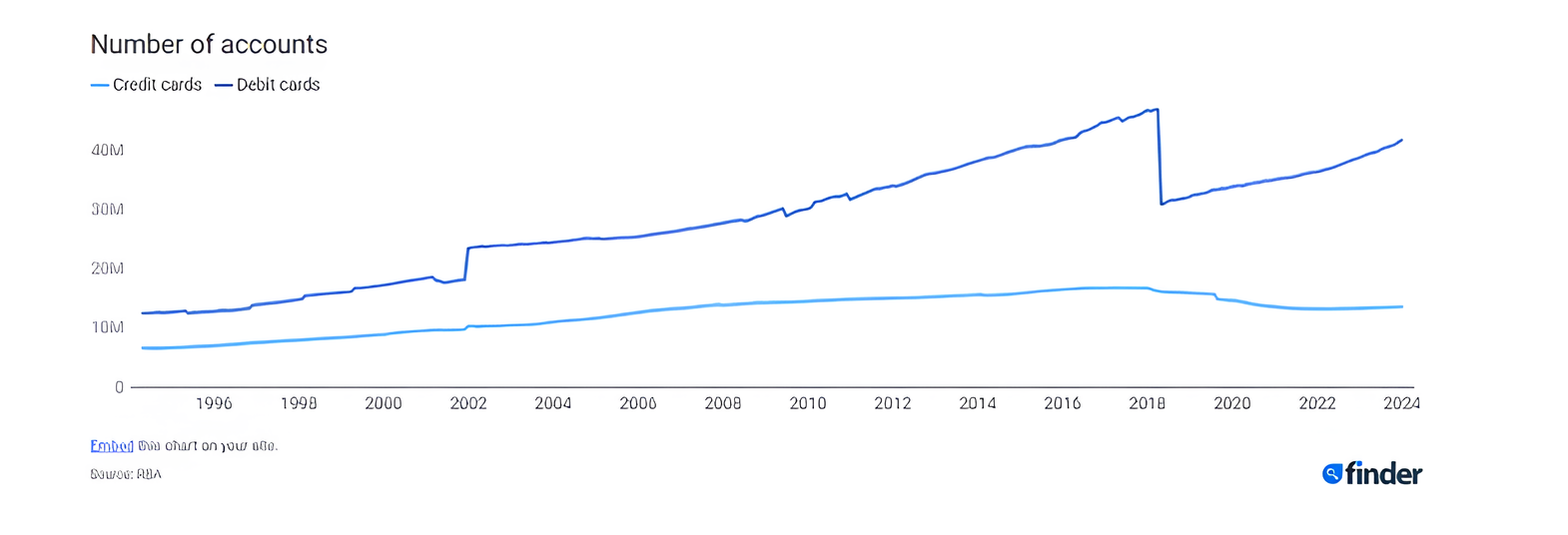
The table below is based on figures published in January 2024:
| Credit Card | Debit Card | |
|
Number of cards issued |
13,518,459 | 41,738,166 |
| Total payments (monthly) |
$35.2 billion |
$49.9 billion |
|
Average monthly spend per card |
$2,607 |
$1,196 |
|
Total number of transactions (monthly) |
309.7 million |
957 million |
| Average monthly transactions per account | 22.9 |
22.9 |
| Average value per transaction | $114 |
$52.14 |
 Frequently Asked Questions
Can I apply for a bank card after migrating to Australia?
Yes, you can apply for a debit card from your very first day in Australia.
What documents do I need to get a debit card?
A passport, valid ID, proof of address and a valid visa.
What documents are needed for the KYC (identity verification) form?
Valid ID (passport, ID card, driving licence or insurance card); a residential address in Australia (a gas or electricity bill from no more than 3 months ago); and a police clearance certificate.