



Australia’s banking system is highly competitive and flexible. Australia’s major banks rank among the world’s top banks, and shares in some of them, such as National Australia Bank (NAB) and Westpac, are also traded on the New York Stock Exchange.
Join us in this PickTalk article as we look at Australia’s banks and their interest rates.
Types of Banks in Australia
Banks in Australia fall into two main groups:
- Banks founded in Australia and run either privately or by the government. The largest Australian banks are: Commonwealth Bank, Australia and New Zealand Banking Group (ANZ), National Australia Bank (NAB), Westpac, Bank of Queensland, Macquarie Bank, Bankwest, Bendigo Bank and AMP Bank Ltd.
- International banks, which are mostly branches of well-known global banks operating in various Australian cities. HSBC, BNP Paribas and Citibank are among the most important international banks operating in Australia.
Australia’s Top Four Banks
In Australian banking, the country’s four largest banks are known as the Big Four. They hold a large share of Australia’s assets and market capitalisation, and offer a wide range of financial services, including retail banking, corporate banking, investment management, all kinds of loans and home loans, business loans, credit cards, insurance and superannuation, foreign exchange services, international transactions and more.
The Commonwealth Bank was founded by the Australian government in 1911. In terms of assets, market capitalisation, number of branches and ATMs, it is regarded as Australia’s largest bank. The Commonwealth Bank holds around $1,252 billion in assets and has more than 740 branches, 1,900 ATMs and 53,000 employees worldwide.
The bank operates in every Australian city, as well as in major cities in China, Hong Kong, Japan, Singapore, New Zealand, the UK and the US.
The Australia and New Zealand Banking Group (ANZ) was founded in Melbourne in 1835. With more than $1,100 billion in assets, it is Australia’s second-largest bank.
It operates more than 830 branches across Australia, New Zealand and other countries, including the US, the Asia-Pacific region and the Middle East.
The Westpac Bank was Australia’s first bank, founded in Sydney in 1817. It has more than 1,200 branches and 2,900 ATMs worldwide. In 2023, Westpac’s assets were estimated at more than $1,000 billion.
It has around 32,620 employees, its head office is in Sydney, and it serves 13 million customers. Westpac’s assets were reported at A$907 billion as of 2019.
National Australia Bank (NAB) was founded in Melbourne in 1858. In 1981, it merged with the Commercial Banking Company of Sydney (CBC) and took the name National Australia Bank. In 2023, NAB was ranked 50th among the world’s 100 largest banks (by total assets and market capitalisation).
The bank has more than 800 branches, 4,600 ATMs and 38,128 employees worldwide.
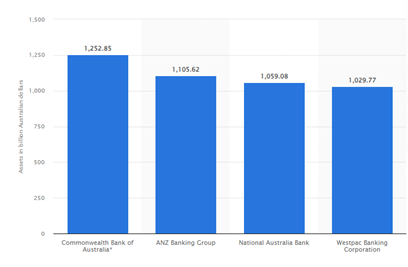
Australia’s largest banks in financial year 2023, by assets (A$ billion)
Bank Opening Hours in Australia
In Australia, business hours are usually 9 am to 5 pm, Monday to Friday.
Bank opening hours in Australia follow much the same pattern:
- Monday to Thursday: 9.30 am to 4 pm
- Friday: 9.30 am to 5 pm
In recent years, however, some banks have started offering services beyond these usual hours.
Public Holidays in Australia
Australian banks are closed on Saturdays and Sundays, on national public holidays and on each state’s special occasions. However, some branches may open on Saturdays. For example, one Commonwealth Bank branch in Melbourne’s CBD offers limited services on Saturdays (from 10 am to 2 pm).
Some of Australia’s national and regional public holidays:
- 1 January: New Year’s Day
- 26 January: Australia Day
- 29 March: Good Friday
- 1 April: Easter Monday
- 25 April: Anzac Day
- 25 December: Christmas Day
- 26 December: Boxing Day
- 11 March: Canberra Day (regional holiday in the Australian Capital Territory)
- 27 May: Reconciliation Day (regional holiday in the Australian Capital Territory)
- 5 July: Alice Springs Show Day (regional holiday in the Northern Territory)
- 14 August: Royal Queensland Show (public holiday in Brisbane)
- 5 November: Melbourne Cup Day (regional holiday in Victoria)
Interest and Bank Returns in Australia
The interest rate is one of the key concepts in banking, and it directly affects the country’s economy. That’s why interest rates are set by the country’s central bank.
Based on economic variables such as inflation, money supply and unemployment, the central bank can raise or lower interest rates. In this way, it controls economic conditions and inflation, and even steers the direction of investment. For example, if the central bank wants to boost investment and spending in the economy, it can cut interest rates.
In Australia, interest rates are set by the Reserve Bank of Australia (RBA). The RBA Board meets on the first Tuesday of each month (except January) and decides whether to change or hold the cash rate. This decision is based on factors such as inflation, economic growth and employment across the wider economy.
According to the Reserve Bank of Australia’s March 2024 report, the interest rate will remain at 4.35% this year.

Changes in Australia’s interest rate
Types of Interest Rates in Australia
Put simply, interest is the cost of borrowing money. In other words, when you take out a loan from a bank or financial institution, you pay an extra cost, called interest, on top of the loan amount.
Interest rates in Australia depend on the type of loan, competition between lenders, the type of deposit account and the return paid to depositors, and even the customer’s financial history and circumstances.
For a typical borrower in Australia, banks usually offer two types of rates: fixed and variable. Each has different features and works differently, but the two can sometimes be combined in a single loan.
- Fixed interest rate: a fixed rate is set for a specific period and stays the same throughout the repayment term. A fixed rate gives the borrower more predictability, so you can plan your monthly and yearly budget more precisely. Even if bank interest rates rise, the change won’t apply to you. But if the bank decides to cut rates, your current loan rate won’t change either. And if you want to repay your fixed-rate loan early, you’ll usually have to pay a “break fee”.
- Variable interest rate: a variable (or floating) rate may rise or fall due to inflation or the country’s monetary policy. One of the main advantages of a variable-rate loan is its flexibility. For home loans, Australian banks and lenders usually offer variable-rate loans with extras such as offset accounts and redraw facilities (often for an additional fee), so you can use your home loan like an everyday bank account.
- Split interest rate: here, the bank offers a combination of fixed and variable rates. For example, the bank lets you repay part of your home loan at a fixed rate and the rest at a variable rate. This way, you can pay off part of your loan at a fixed rate and stay protected from possible rate rises, while using features such as offset accounts and redraw for the rest of the loan.
Note: in Australia, loan interest rates are set by each bank. Currently, interest rates at the Big Four range from 6.5% to 9%, and at other banks from 5.9% to 9%.
Types of Bank Returns in Australia
In general, savings rates are set according to the country’s inflation rate and economic growth. In Australia, however, the rate also depends on the bank and the type of deposit account you have. Currently, bank savings rates in Australia are between 1 and 3 percent, although some banks may offer higher rates for long-term deposits.
Everyday accounts (Transaction Accounts): this type of account is suited to everyday use, such as paying bills and receiving your salary. These accounts don’t earn interest, but you can use them to apply for a loan or credit card.
Savings accounts (Savings Accounts): with this type of account, you keep a certain amount of money in your account and earn interest on it, as long as your balance reaches the minimum set by the bank. Interest from Australian banks is very low compared with Iran. For example, savings accounts earn between 1 and 2 percent interest.
Some banks may pay higher interest, but with special conditions — for example, you must deposit money into your account regularly and make no withdrawals.
Term deposit accounts (Term Deposit Accounts):
Term deposits earn more interest than other accounts. With this type of account, you must keep a set minimum balance for a fixed period (usually 1 month to 5 years). Note that you can’t withdraw from your account during this time. The interest rate on term deposits is usually fixed and is paid at the end of the term.

Frequently Asked Questions
1- What types of bank accounts are there in Australia?
Transaction, savings and term deposit accounts.
2- Which are Australia’s top four banks?
Commonwealth Bank, National Australia Bank (NAB), Westpac, and the Australia and New Zealand Banking Group.
3- Which banks in Australia issue credit cards to temporary visa holders?
Commonwealth Bank, ANZ, NAB, Westpac, American Express and HSBC.